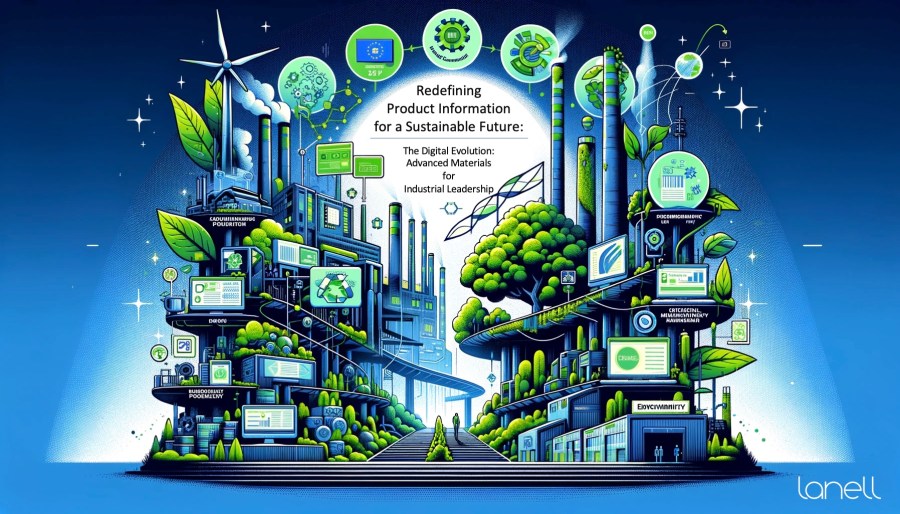
In an era where sustainability and digital innovation intersect, the European Commission’s strategy on “Advanced Materials for Industrial Leadership” outlines a transformative path for manufacturing and product information. This document underscores the strategic imperative of decommoditizing product information, advocating for a nuanced approach where product data becomes a strategic asset. It emphasizes the urgent need for a robust digital infrastructure capable of supporting a new industrial landscape that prioritizes sustainability, innovation, and comprehensive data management.
Central to this transformation is the Digital Product Passport (DPP) initiative, designed to revolutionize product traceability, lifecycle management, and support for the circular economy. This initiative underscores the transition towards a more sustainable and innovative European market, highlighting the necessity for scalable, secure, and interoperable digital platforms. These platforms are envisioned to serve as the backbone for managing intricate product information, enabling real-time data access, sharing, and decision-making across the value chain.
A pivotal aspect of this journey is the evolution from static data models to dynamic digital twins. Traditional models, limited in their adaptability and real-time update capabilities, are yielding to digital twins’ live, interactive replicas of physical products. Digital twins facilitate a comprehensive understanding of products throughout their lifecycle, enabling continuous optimization and more sustainable strategies. This dynamic approach enhances the Digital Product Passport’s functionality, providing detailed transparency that static models cannot match.
The strategy’s emphasis on advanced materials and digital infrastructure invites industry leaders, policymakers, technologists, and environmental advocates to collaboratively develop the standards, technologies, and practices driving this transformation. By investing in digital infrastructure and embracing the principles of the DPP and digital twins, we can forge a sustainable, innovative, and resilient future.
The European Commission’s strategy is more than a policy document; it’s a roadmap for the digital age, urging us to redefine product information management. As we implement the DPP and enhance our digital infrastructure, embracing digital twins, we face an unparalleled opportunity to drive innovation, sustainability, and economic resilience. This transformative journey towards a digital, greener future is filled with challenges and opportunities, calling for collaborative efforts to redefine the boundaries of product information management and manufacturing.
In an era where sustainability is no longer a choice but a necessity, Digital Product Passports (DPPs) are emerging as a pivotal tool for companies committed to showcasing the sustainability credentials of their products. This innovative approach, which encompasses a wide range of products from batteries and textiles to furniture and cosmetics, is revolutionizing how companies communicate their commitment to environmental stewardship.
At the forefront of this transformative shift is Lanell’s founder, Niels Stenfeldt, a renowned expert in the field of digital sustainability solutions. Stenfeldt’s pioneering vision and expertise have positioned Lanell as a beacon for companies seeking to navigate the complexities of sustainable product certification. With a clear understanding of the evolving landscape of sustainability requirements, Lanell invites businesses to explore the benefits of Digital Product Passports and leverage this technology to foster greater trust and transparency with consumers.
The Essence of Digital Product Passports
Digital Product Passports serve as a digital twin for physical products, providing detailed sustainability information that consumers can easily access. This transparency is not just about meeting regulatory requirements; it’s about empowering consumers with the knowledge to make informed decisions, thus promoting a circular economy through the principles of conservation, reuse, and recycling.
Legislative Landscape
In the European Union, the implementation of Digital Product Passports is becoming a legal requirement for companies distributing products within its member states. This mandate is part of a broader legislative framework aimed at enhancing product sustainability across various sectors.
Requirements at a Glance:
Data Carrier: A means to access the DPP, such as QR codes, NFC tags, or product watermarks, must be provided.
Product Identification: DPPs should detail the product model, manufacturing batch, or specific item.
Interoperability: Ensuring DPPs can work seamlessly across different platforms.
Consumer Access: Free and unrestricted access to DPP data for consumers.
Data Integrity: Companies are responsible for the accuracy and security of the data within the DPP.
Sustainability Indicators: Information on the product’s environmental impact, including carbon footprint and recycled content.
Industry-Specific Considerations
While the Digital Product Passport initiative spans various industries, certain sectors like batteries, ICT, textiles, and plastics are at the forefront of these requirements. For instance, battery manufacturers must now include comprehensive details ranging from the battery’s chemistry and weight to its carbon footprint and disposal instructions.
Encouraging Action
Niels Stenfeldt and Lanell are not just navigating these regulatory waters but are actively encouraging businesses to embrace Digital Product Passports as a means to validate their sustainability claims. By doing so, companies can avoid the pitfalls of greenwashing, ensuring that their actions are backed by transparent and reliable data.
Conclusion
As we stand at the cusp of a sustainability revolution, the implementation of Digital Product Passports offers a clear path forward for companies to demonstrate their commitment to environmental stewardship. With industry leaders like Niels Stenfeldt guiding the way, businesses have a unique opportunity to transform their sustainability practices, fostering a more transparent, responsible, and circular economy.
For companies looking to navigate this new landscape, reaching out to experts like Stenfeldt and his team at Lanell can provide the necessary guidance and support to implement effective Digital Product Passport strategies. Together, we can build a more sustainable future, one product at a time.
Fact Box: Battery Passport Requirements
Objective: Enhance transparency and sustainability in battery production and usage.
Applies to:
Industrial batteries with a capacity greater than 2kWh
Electric vehicle (EV) batteries
Light means-of-transport (LMT) batteries, e.g., for e-bikes
Key Information Required:
Manufacturer Details: Name, address, and contact information
Battery Specifics: Category, model identification, and batch/serial number
Manufacturing Info: Place and date of manufacture
Physical Attributes: Battery weight and chemistry
Safety Measures: Hazardous substances (excluding mercury, cadmium, or lead) and usable extinguishing agents
Environmental Impact: Critical raw materials over 0.1% by weight, carbon footprint, and recycled content
Technical Indicators: Performance and capacity metrics
Compliance: EU declaration of conformity, disposal, reuse, and recycling information
Fact Box: Industries and Digital Product Passports
Affected Industries:
Information and Communications Technology (ICT)
Electronics
Batteries & Vehicles
Textiles / Fashion
Plastics
Furniture
Construction and Buildings
Chemicals
Industries Not Required for Digital Product Passport:
Food and Feed
Medicinal Products and Veterinary Medicinal Products
Living Plants
Animals and Micro-organisms
Products of Human Origin
Products Relating to Future Reproduction of Plants and Animals
These fact boxes highlight the specific requirements for battery passports under the Digital Product Passport initiative, and delineate the industries impacted by, and exempt from, these new regulations.
In January 2024, California witnessed a staggering 510 cases leading to 60-day Notices of Violation under Proposition 65. This regulation, aimed at safeguarding the public from harmful chemicals, has spotlighted a massive compliance opportunity for vendors. The violations spanned across various categories, with significant notices for lead, phthalates, and other chemicals in products ranging from bags, ceramics, to personal care items.
Why does this matter for your business? Beyond the immediate legal implications, these numbers reveal a deeper issue in how product information is managed and presented across packaging to commercial endpoints. The discrepancies leading to these violations often stem from inaccurate or outdated product data – a problem that accurate digital twins can solve.
Digital twins – precise digital representations of physical products – ensure that every detail, from chemical composition to regulatory compliance, is accurately mirrored across all platforms. This not only mitigates the risk of regulatory violations but also enhances consumer trust and transparency.
Here’s the kicker: Prop 65 is just the tip of the iceberg. With the ever-evolving landscape of global regulations, the need for meticulous product information management has never been more critical. By investing in accurate digital twins, businesses can:
Ensure Compliance: Stay ahead of regulations by maintaining up-to-date and precise product information.
Build Trust: Transparently share product information with consumers, boosting confidence and loyalty.
Seize Market Opportunities: Quickly adapt to new regulations, turning compliance into a competitive advantage.
January 2024’s 510 notices aren’t just a wake-up call; they’re a glimpse into the future of regulatory compliance. In a world where regulations are bound to get tighter, the ability to swiftly and accurately update product information across all endpoints is not just beneficial – it’s essential.
Let’s embrace this massive opportunity. By prioritizing the development and implementation of accurate digital twins, your business can lead the way in compliance, transparency, and consumer safety. The future is digital, and the future is compliant. Are you ready to take the lead? If not, contact us at Lanell.
Congratulations to Thomas H. Lee Partners (THL) for their investment in inriver – and congratulations to Verdane for continuing their journey with inriver.
It has been a pleasure working with Gazal Sikand, Jeff Swenson, Jesse Searby, Tabish Valliani, Rohan Angle, Ben Y., Sarah Spotts, MBA, Cliff Longley and the entire THL team assisting them with this strategic growth investment.
I appreciate the trust they placed in me and my experience and industry relationships as we together with the inriver executive leadership team, investors, bankers, Boston Consulting Group (BCG) and other advisors to agree on this investment.
Congratulations to CEO Thomas Zanzinger and Chairman Jorgen Smidt on leading the business to this successful outcome. And special congratulation to Johan Boström and his co-founding team with Johan Billgren, Fredrik Gustavsson, and Roland Persson who started inriver back in 2004. And lastly to Pål Malmros from Verdane.
As a Dane with Swedish roots, it has been a pleasure to follow the company and see what passion, friendship, hard work, humble confidence and dedication from all the people in the organization, partner network, and customer community combined with the right owners can achieve together.
I’m happy to have been part of helping THL with this growth investment that will enable inriver to double down on their vision, strategy, and ambitious goals.
As an expert member of the Danish Regulatory Foum I can testify that the number of regulatory initiatives which are also requiring non-financial disclosure is growing rapidly. A recent report shows that between 2013 and 2018, there has been a 72% increase in the number of recorded regulations. Especially in the past years, this trend took an even broader and more defining role and are the reason of this CSRD related post.
On an EU level, the Non-Financial Reporting Directive (NFRD) came into effect in all member states in 2018. Since then, all 28 countries have adapted the NFRD into national law, and it is now up to companies to comply. With the EU Taxonomy, the Corporate Sustainability Reporting Directive(CSRD), and the Sustainable Finance Disclosure Regulation (SFDR) among others, the European Union is moving on to the next step of regulations on sustainability reporting and sustainable finance. More precisely, the CSRD aims to ensure that businesses report reliable and comparable sustainability information to re-direct investments towards more sustainable technologies and companies. It is estimated that this would affect around 50.000 companies in the EU.
In April 2021, the European Commission published its proposal for the CSRD to replace the existing NFRD. The NFRD is undergoing a fundamental update with the CSRD. While the proposal still has to pass through the instances, it already offers a preview of the changes that will come to companies, banks, and insurance companies. The current stage of “passing through the instances” brings lots of uncertainty and constant changes. With this post, it is my intention to to draw a picture of what is happening right now as it will generate several market opportunites in european Enterprice software market.
Following its adoption at the EU level, the directive must be transposed into national law by December 1st, 2022 for it to take effect for companies. That is in a littel more than 6 month. According to the previous timetable, the regulations are to apply from January 1st, 2024 for the 2023 financial year. However, the timetable appears to have been pushed back, proposing a delayed introduction and change of scope.
Framework
The proposed directive introduces European reporting standards, which are still in development. According to current proposals, the CSRD will be composed of sector-independent, sector-specific and organization-specific standards.
Additionally, it adopts a so-called “double materiality” approach, which will change the principle of materiality that is currently known, particularly in Germany. The “double materiality” requires companies to report on both the impact of sustainability on segments on their balance sheet as well as the impact companies have on the environment and society.
If the EU sticks to its current schedule, the first core standards will be available for review by mid-2022 and adopted by October 31, 2022. As of now, a slimmed-down version of the standards for SMEs will be available by October 31st, 2023 .
Who will be affected by the CSRD?
Compared to the NFRD, the CSRD aims to significantly expand the scope of companies subject to reporting requirements:
All large companies with 250 employees or more, regardless of a capital market orientation. The second threshold for large companies continues to be a turnover of > 20 million euros or sales of > 40 million euros.
All capital market-oriented small and medium-sized enterprises, except for micro-enterprises (from 01.01.2026). According to Directive 2013/34/EU, companies are considered small if they exceed two of the three characteristics 1) 10 employees, 2) 350,000 euros total assets and 3) 700,000 euros net sales (see also chapter timeline changes).
Reporting at the Group level continues to exempt subsidiaries from their reporting obligations. The subsidiary must refer to the Group report.
What kind of information need to be disclosed?
The CSRD will require a statement containing all information necessary for an understanding of the organization’s business performance, results, position, and the impact of its activities.
In the future, the required information needs to be included in the annual management report. This is to be published no later than four months after the end of the financial year. The publication has to be in a machine-readable format.
Possible timeline and -scope changes:
The European Parliament and the Member States are continuing their negotiations on the CSRD proposal. The European Parliament has now announced its position, introducing several changes to the proposed legislation.
One part of these changes demands that SMEs would be taken out of the scope of mandatory reporting. Since SMEs form an essential part of the European economy, with most business enterprises in Europe belonging in this category, this would be a setback for the EU towards achieving net-zero. Initially, SMEs were included via a simplified framework with a three-year application delay compared to the timeline for large companies.
As the second part of these changes, the European Parliament asked for a delayed implementation of CSRD by one year. The delay means that all large companies will be required to disclose in line with the new rules as of 2024, publishing their reports in 2025.
While these changes are not finalized, many involved parties have expressed concern about a possible delay and scale-down of scope as it would create a clear risk of a funding gap at a critical time for the EU economy.
New challenges for companies and how DFGE can help
The CSRD builds on existing concepts of sustainability reporting. Larger capital market-oriented companies have long been required to disclose sustainability information.
Nevertheless, there is still a significant proportion of companies that do not yet conduct sustainability reporting, or at least not yet to the structured extent that is expected by the CSRD. Due to the expanded group of reporting companies, it will be a major challenge to introduce sustainability reporting across the board and establish appropriate processes for reporting.
In addition, for the companies already reporting, the requirements for data quality and data scope will increase. Companies will have to make their sustainability information auditable and potentially develop new topic areas. The collection of quantifiable key figures, the setting of concrete targets, and the progress report on the achievement of these targets represent further key challenges of the new reporting obligation.
As compliance with the CSRD calls for increasing integration of sustainability aspects into corporate strategy, the CSRD fundamentally strengthens the trend toward anchoring sustainability aspects more and more into business.
European Commission (2021). Proposal for a Directive of the European Parliament and of the Council amending Directive 2013/34/EU, Directive 2004/109/EC, Directive 2006/43/EC and Regulation (EU) No 537/2014, as regards corporate sustainability reporting (Proposal Corporate Sustainabiltiy Reporting Directive (CSRD)). ( https://eur-lex.europa.eu/legal-content/EN/TXT/?uri=CELEX:52021PC0189 )
In recent years, France has become a beacon of legislative innovation with the adoption of the “loi AGEC” (Anti-Waste for a Circular Economy) in 2020. This groundbreaking law has introduced a series of pragmatic and straightforward measures aimed at drastically reducing waste and fostering a circular economy. Its impact is pervasive, subtly altering consumer experiences in stores and restaurants across the country – changes so seamlessly integrated into daily life that many may not realize they’re a result of stringent legal mandates.
The AGEC law mandates significant shifts away from disposable consumer culture: the replacement of disposable tableware in restaurants with reusable alternatives, the cessation of distributing plastic toys in favor of eco-friendly paper or cardboard versions, the reduction in unnecessary plastic bottle distribution at public events, and the move towards digital or requested-only receipts, among others. Even the acceptance of reusable containers by retailers and restaurants for takeout orders marks a commendable step towards reducing single-use plastic consumption.
However, beyond these visible changes lies a more profound implication for how businesses and consumers interact with products and their lifecycle information. This transition heralds a significant push towards digital transformation, emphasizing the need for dynamic, accessible product information- a shift from static information to the innovative concept of digital twins.
The Digital Twin: A new paradigm for product lifecycle management
The AGEC law, while primarily focused on waste reduction and the promotion of a circular economy, inadvertently underscores the necessity for a more sophisticated approach to product information management. In a world increasingly concerned with sustainability, the static nature of traditional product information proves inadequate. This is where the concept of the digital twin comes into play—a digital replica of a physical product that captures its entire lifecycle from production to disposal.
Digital twins represent a quantum leap in how we understand, interact with, and manage products in a sustainable manner. They allow for real-time tracking of product use, end-of-life management, and the environmental impact of products. This capability aligns perfectly with the goals of the AGEC law, providing consumers and businesses with the transparent, actionable information needed to make more responsible choices.
Why the AGEC law foretells the future of digital product passports and product environmental footprints
The effectiveness of the AGEC law in France serves as a powerful example of how legislative action can drive substantial environmental benefits and transform consumer behavior. It also signals a broader shift that could be amplified and extended through the adoption of an upcoming initiatve in the EU called Digital Product Passports (DPPs).
DPPs, much like digital twins, will evidently offer a detailed, dynamic record of a product’s environmental footprint, materials, and end-of-life handling options. At Lanell, we believe they will not only be a tool for compliance but for driving deeper consumer engagement with sustainability. As we observe the positive impacts of the AGEC law, it becomes evident that the logical next step is to expand these principles globally, leveraging technology to provide a more comprehensive, accessible view of product sustainability.
The circular economy: A model for the future
The transition towards a circular economy, and embodied in the AGEC law, represents a fundamental shift in our relationship with products and resources. It’s a model that prioritizes reuse, repair, and recycling over the linear extract-produce-consume-waste paradigm, resonating with the planet’s ecological boundaries.
As we look forward to the broader adoption of principles similar to the AGEC law worldwide, several critical questions arise. How will the impact of these legislative actions be measured? What strategies will other nations adopt to combat waste and promote sustainability? And importantly, how can we ensure that recycling, while necessary, is viewed as a last resort rather than a carte blanche for continued consumption? At Lanell we can help with this.
Conclusion: A call to action for global sustainability
The AGEC law’s introduction in France is not just a local success story; it’s a clarion call for global action towards sustainability. As digital transformation continues to redefine every aspect of our lives, the integration of digital twins and digital product passports emerges as a crucial tool in this journey. These technologies offer the potential to extend the principles of the AGEC law beyond French borders, providing a blueprint for sustainable consumption that respects our planetary boundaries.
By closely examining and learning from the AGEC law’s implementation, we can gather insights and inspiration for crafting more sustainable futures worldwide. It’s a testament to the power of legislation, technology, and collective action in shaping a world where sustainability is not just an aspiration but a reality.
It will be interesting how far we have come in two years for now. At Lanell we predict it will come slow – but then take off like a hockey stick.
With the development of Boyum cloud applications, Boyum have today started their internal and external communication to inform partners about these upcoming innovations and to get valuable feedback.
Today, they are several steps ahead, making significant progress, and are proud to have already released 3 powerful role-based cloud applications that continue growing and evolving. Therefore, Boyum today takes the opportunity of re-branding and positioning their products Build, Produce and Inspect as well as future products as standalone cloud applications. All of these products will be part of a product family that we call Cloud Apps.
Website content that was previously available on boyumcloud.com has already been moved to the boyum-solutions.com site. Check out the new pages here! Marketing, sales and pre-sales resources are still available through their Marketing Resource Hub, you can find them under the product names Build, Produce and Inspect.
This re-branding is an important step for the right positioning of the Cloud Apps as well as for achieving the strategic goals.
Lanell suggest to listen to the latest podcasts and learn more about the cloud apps Build, Produce and Inspect, which target group they serve and the problems they can solve.
Lanell has detected fraudulent use of its brand, one of its company names (“Stenfeldt Capital Aps”) and its Danish office address by a company via http://www.stenfeldtcapitalaps.com.
The company is wholly unconnected to Lanell and Stenfeldt Capital, and measures are currently being taken to remedy the situation (including files with Danish Police and US SEC). We strongly advise any individuals or organisations contacted by the company to refrain from engaging in any and all business activity or collaboration.
For further information, please contact info@lanell.com.





 lanell.com